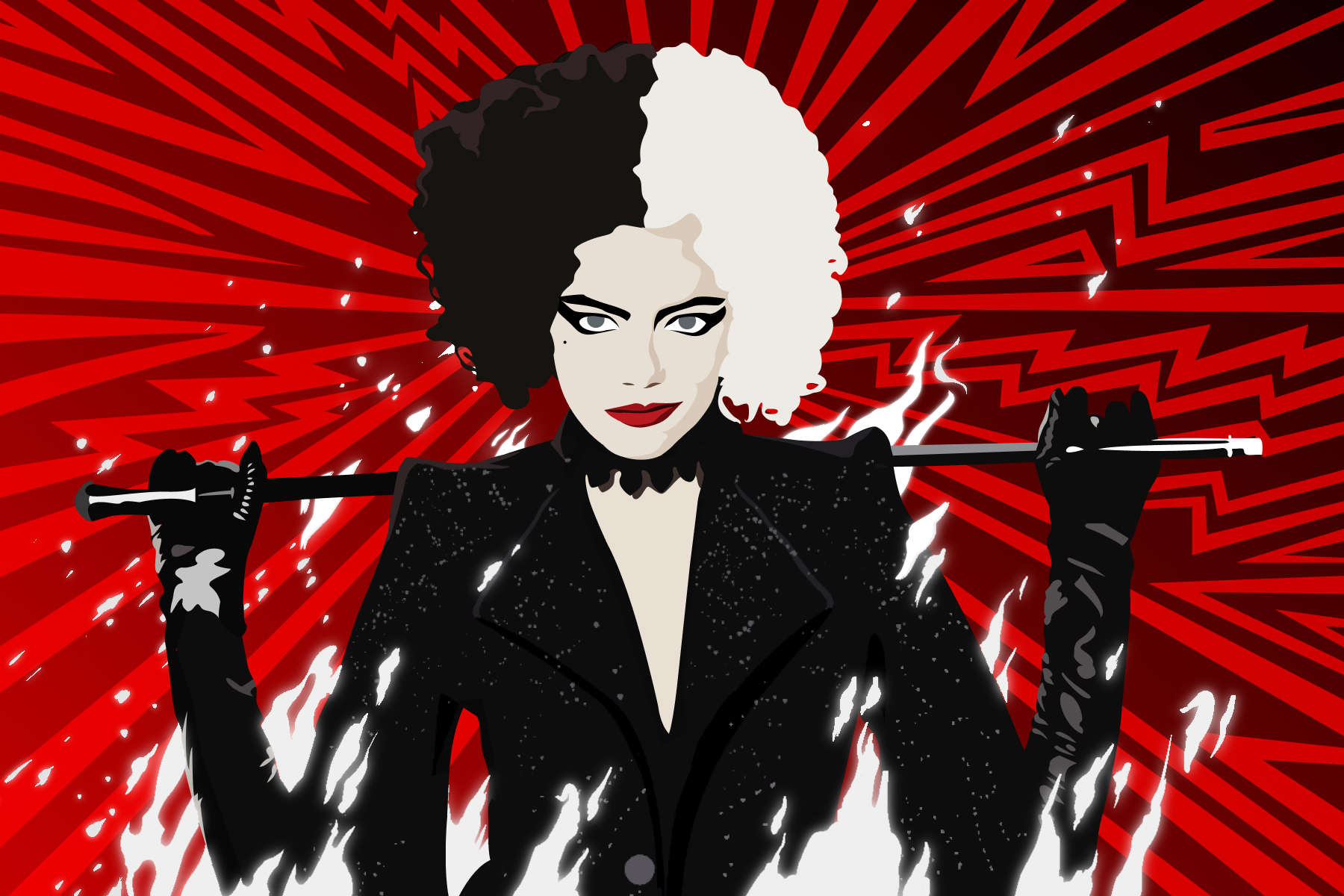

Cruella de Vil’s first-ever onscreen appearance must be one of the most memorable sequences in Disney history. From the 1961 animated film “101 Dalmatians,” the scene opens with a song warning the audience: “If she doesn’t scare you, no evil thing ever will!” A spiky silhouette rises from behind a glass door as Cruella is revealed, her spidery frame enveloped by a black and white fur coat. She waltzes inside the house and waves a long cigarette as she discusses puppy-buying and puppy-skinning. Though she leaves less than two minutes later, her brief yet unsettling presence completely disrupts the film. It’s an electrifying introduction, and it’s the reason why she’s one of the most famous Disney villains. Though the new Disney live-action film “Cruella” harnesses the same vein of eccentricity, it never quite manages to surpass its predecessor.
MILD SPOILERS AHEAD!
“Cruella” belongs to two of the most popular Hollywood trends in recent years. Like “The Lion King,” “Mulan” and “Cinderella” remakes, it has become a part of the industry’s strategy of capitalizing on nostalgia by producing spin-offs, remakes and reboots of beloved film pieces. And similar to “Joker” or “Maleficent,” it’s another entry in the “thriving genre of villain revisionism.” The two trends converge to narrate Cruella de Vil’s origin story. In the first half of the film, it is revealed that Cruella becomes an orphan after an encounter with Dalmatians kills her mother. She grows up roaming the streets of London and eventually becomes an employee of the Baroness, the ruthless queen of the high fashion establishment. Though at first Cruella tries to play by the rules of the Baroness, a series of revelations convinces her that she must destroy the Baroness at any cost.
It’s “Oliver Twist” meets “The Devil Wears Prada” in 1970s London. At its best, the unlikely combination of genres and styles works in the film’s favor, and the cinematography is forgettable but still well-executed. For example, during Cruella’s first impromptu fashion show, the camerawork successfully plays up the non-naturalistic and heightened universe of the film.
Though the excessive amount of inane needle drops brings the shortcomings of “Suicide Squad” to mind, the editing is skillful and infuses the first half of the movie with excitement and vitality. But the best thing about “Cruella” is how it’s as fashion-obsessed as its title character. From lavish excess to punk eccentricity, each of the 80+ outfits is a delight to the eyes. With their clashing styles and dazzling performances, it was thrilling to watch Cruella and the Baroness appear onscreen at the same time.
However, this is not enough to save the film from its failures. “Cruella” lasts a little more than two hours; on first watch it’s entertaining to see the plot twist into increasingly nonsensical shapes, but it barely holds up on a second viewing. One gets the impression that it could have been half as long and twice as good, a feat that could have been achieved by dropping plenty of unimportant subplots and scenes. For instance, Anita Darling’s plotline is hardly given any attention, and her character is a textbook example of the tired trope of the token black friend.
Perhaps the film’s biggest mistake is its desperate attempt to redeem its main character. The Cruella that Emma Stone portrays is not a villain but a flawed woman with a quirky temperament. She has a heart of gold! She’s a girlboss! She doesn’t kill any dogs! In fact, she loves dogs! And they love her too! The film trips over itself to make Cruella a nuanced character when her main appeal is actually her sadistic, selfish and cartoonishly evil nature.
Instead, those diva sensibilities are given to the Baroness — a choice that oddly flattens Cruella into an underdog. Disney took on a harrowing challenge in attempting to prop up an entire movie based on a gleefully unlikeable character. But “Cruella” is no “Joker” when it comes to its ability to create empathy with the famous antagonist, nor does it provide the villainess with a complex array of emotions that the audience can truly understand.
The general reaction to “Cruella” could be summed up by a shrug. One critic pointed out that it “could’ve been worse,” whereas another more favorable review from The Sydney Morning Herald stated that the film would “at least succeed in distracting you.” Its harshest critics have gone so far as to call it “an atrocity with neither purpose nor soul.” Even its kindest reviewers have to admit that with the lack of sincerely intense emotions, it was “easy enough to watch but hard to care much about.”
No moment of the film holds up to the original “101 Dalmatians,” just like none of the recent Disney reboots have held up to their predecessors, and perhaps that’s the point. As Simran Hans wrote in a 2019 analysis regarding the decline of creativity, the endless parade of spinoffs, remakes and reimaginings is designed to be low-risk and low-effort. By recycling the same stories, the Walt Disney Company is able to reap easy profits, since its enormous share of the U.S. market (40% in 2019) allows its movies to thrive regardless of their quality.
As a result, it feels like mainstream studios are keeping their audiences in a purgatory of reboots, remakes, sequels, prequels and reimaginings. They release products that are far from being unsuccessful and even further from being beloved. We have yet to learn if these remakes will have the same, if any, level of success with the next generation. A failure to connect with the audience would be a failure to profit for the studios, which could point us toward the end of the remake era. But for now, it seems like the future holds more releases like “Cruella”: bland, deeply average movies that capitalize on the cherished childhood memories of previous enjoyment.






Really nice list. I will take a look at these pieces to see if I can find diamond grow a garden
og great post
Grow A Garden
The comparison between the 1961 silhouette introduction and this new version really highlights why “villain revisionism” can be such a double-edged sword. While Emma Stone is undeniably talented, the article hits the nail on the head regarding that loss of pure, unsettling energy. When you take a character defined by a terrifying, brief presence and try to stretch her into a full-length origin story, you often end up losing the very mystery that made them iconic in the first place. It feels like Disney is prioritizing brand familiarity over actual character impact. I’ve noticed this trend in other media too; when you try to explain the “why” behind a legendary antagonist, you sometimes strip away their power. I actually looked into how character archetypes are reshaped in gaming guides on Abyss Roblox Codes and found that players usually prefer a clear, intimidating role over a complicated backstory. It’s a tough balance to strike when you’re trying to satisfy both nostalgia and modern storytelling.
The comparison between the 1961 silhouette reveal and this new version highlights exactly why villain revisionism is such a tricky tightrope to walk. That original scene worked because it was pure, concentrated menace—it didn’t need a backstory to be terrifying. By trying to turn Cruella into a misunderstood anti-hero, the film loses that specific “evil” spark that made her iconic in the first place. I definitely feel like Disney is hitting that saturation point mentioned in the intro; when every character needs a complex origin story to justify their actions, the magic of a pure antagonist starts to fade. I’ve been exploring how character archetypes shift in modern media over at lily lovebraids and it’s interesting to see how much we rely on those classic, simple tropes. While the fashion in this movie was stunning, it felt like it was compensating for a lack of that original, unsettling energy. It’s watchable, sure, but it lacks the soul of the animation.
The comparison between the 1961 silhouette introduction and this new version really hits the nail on the head. There is something about that original, unsettling brevity that made Cruella a legend, whereas the live-action version feels like it’s trying a bit too hard to justify her existence through a long origin story. I definitely see the “villain revisionism” trend you mentioned, but it feels like Disney is running out of fresh ways to make us sympathize with characters who were designed to be purely iconic and terrifying. It’s a bit like when developers try to over-explain a legendary character’s backstory instead of letting their presence speak for itself. I actually looked into how much character depth is lost when you lean too hard into these reboots, similar to how I analyze complex mechanics on the Borderlands 4 toolkit, and it seems the mystery is what usually makes a character stick. This movie is stylish, sure, but it lacks that specific, sharp edge that made the animated version so haunting.
The way you described that opening sequence from the 1961 original really captures why the character works so well—it’s all about that immediate, unsettling impact. While Emma Stone is clearly talented, I feel like the “villain revisionism” trend often loses the very essence of what made the antagonist scary in the first place by trying too hard to make them relatable. When you turn a force of nature into a misunderstood protagonist, you lose that edge that makes them iconic. It feels like Disney is leaning so heavily on nostalgia that they’re forgetting how to build new tension. I was looking for something similarly atmospheric and immersive on a Subnautica 2 Map recently and found that true tension often comes from the unknown rather than a scripted backstory. This movie is stylish, sure, but style shouldn’t be a substitute for the raw, chaotic energy the original animation provided.
The way the article describes that original 1961 silhouette reveal really hits home; there was something about the sheer simplicity of that animation that felt more menacing than any high-budget live-action costume could ever achieve. While I enjoyed seeing Emma Stone’s take on the character’s eccentricity, I wonder if the “villain revisionism” trend is actually stripping away the mystery that made these characters iconic in the first place. When you try to explain every motive and give every antagonist a sympathetic backstory, you risk losing that pure, unsettling energy that makes a villain truly memorable. It feels like Disney is prioritizing brand familiarity over creating something genuinely new or frightening. I was actually looking for a way to capture a bit of that dramatic, cinematic flair through music recently on Song For You, and it made me realize how much the right atmosphere matters more than just the visual spectacle. Is it just me, or are these reboots starting to feel a bit too safe?
The comparison between the sheer impact of that 1961 silhouette reveal and this new version highlights exactly why “villain revisionism” is such a tricky tightrope to walk. While Emma Stone is clearly talented, the article hits the nail on the head regarding the loss of that unsettling, immediate menace that made the original Cruella so iconic. It feels like Disney is trying to trade genuine character terror for high-fashion aesthetic, which works for a few scenes but lacks the soul of the animation. I often find myself looking for that same kind of “perfect value” in character development as I do when checking Blox Fruits Trading for accurate trade values; if the core essence of what makes a character (or a trade) legendary is stripped away for something more polished and safe, the whole thing just feels hollow. It’s watchable, sure, but it doesn’t leave you feeling that same electric chill that the original did.
The comparison between the original 1961 silhouette reveal and this new version really hits on why these reboots often feel hollow. The article mentions how the original Cruella’s presence was unsettling and disruptive in just two minutes, whereas the live-action version tries way too hard to build up that “villain revisionism” through long, drawn-out backstories. I feel like Disney is leaning too heavily on the “Joker” formula of making every antagonist a misunderstood anti-hero, which actually strips away the pure, chaotic menace that made the animated character so iconic. It’s a bit like when a classic arcade game gets a modern remake that adds too many unnecessary mechanics; you lose the fast-paced, visceral impact of the original. I actually explored how much “flavor” is lost when you over-explain a character’s motives over on OrbitDash, and it seems to be a recurring issue with these big-budget nostalgia plays. They give us more screen time, but less of the actual soul that made us care in the first place.
The comparison between the 1961 silhouette reveal and this new live-action version really hits on why these reboots often feel hollow. That original two-minute introduction worked because it relied on pure, unsettling atmosphere rather than just trying to be “eccentric” for the sake of it. While Emma Stone is talented, the film feels like it’s trying too hard to justify the villain revisionism trend you mentioned. It turns a terrifying icon into a misunderstood fashionista, which takes away the edge that made her legendary. I’ve noticed this pattern a lot lately where studios prioritize nostalgia over actual character depth. I actually looked into how these character tropes are evolving over at OrbitDash and it seems like we are stuck in this loop of reimagining villains just to see if they can be heroes. It makes me wonder if Disney will ever stop leaning on these remakes and start creating truly original villains that can actually scare us again.
The point about “villain revisionism” really hits the nail on the head here. There is a very fine line between giving a character depth and completely stripping away the menace that made them iconic in the first place. In the 1961 version, her presence was felt through pure, unsettling energy, whereas the live-action version feels like it’s trying way too hard to make us sympathize with her backstory. It’s a common trap when studios try to modernize these legends. I’ve noticed a similar trend in how character motivations are being reworked in modern gaming meta-narratives; sometimes, a character is just more effective when they are unapologetically the bad guy. I actually spent some time analyzing character dynamics and power scaling on Marvel Rivals S8 Tools and found that players often prefer characters with clear, distinct archetypes rather than those with overly complicated, “relatable” backstories that dilute their core identity. If Disney keeps leaning into this nostalgia-driven revisionism, they might lose the very edge that made these villains worth watching.
The comparison between the unsettling silhouette of the 1961 original and this new version really hits the nail on the head. There is something about that brief, two-minute introduction in the animated film that creates a sense of pure, unadulterated menace that a full-length origin story struggles to replicate. When you spend two hours trying to make a villain sympathetic through a “villain revisionism” lens, you often lose that raw, terrifying edge that made them iconic in the first place. It feels like Disney is prioritizing aesthetic and nostalgia over the actual soul of these characters. I was reading about similar trends in character deconstruction over on Plants vs Brainrots Hub and it’s interesting how often the “reboot” fails to capture the lightning in a bottle from the source material. It makes me wonder if we are actually entering a saturation point where these remakes just become hollow exercises in style rather than substance.
You’re right about Cruella’s animated introduction being incredibly iconic. That scene is pure evil distilled into a few minutes, and it’s hard to shake. I appreciate the attempt to give her a more nuanced backstory in the live-action version, but I agree it doesn’t quite capture that same terrifying spark. It feels more like an origin story for a misunderstood anti-hero than for the pure villain we know. It makes me wonder if Disney is pushing this “villain revisionism” a bit too hard lately. Sometimes, a villain is just a villain, and that’s what makes them so compelling. I’ve been exploring different kinds of characters and narratives on OrbitDash, and it’s interesting how much depth you can find even in simpler, action-oriented roles.
The article touches on Cruella’s electrifying introduction in the animated film, and I agree that the live-action version struggles to match that intensity. It’s fascinating how a villain’s origin can be reimagined to explore their complex motivations, much like “Joker” or “Maleficent.” However, I wonder if this trend of villain revisionism, while popular, sometimes dilutes the impact of the original characters. I’ve explored how even simple codes can have unexpected depths on my site, MorseTranslator, and it makes me think about how deeply rooted character archetypes, like Cruella’s, can be explored and potentially altered. It’s a delicate balance to strike between offering a fresh perspective and retaining the essence that made them memorable in the first place.
The article makes a great point about how Cruella’s original introduction in “101 Dalmatians” was so impactful and unsettling, despite being so brief. I feel like that’s a tough act to follow, and the new film, while stylish, doesn’t quite capture that same spark. It’s interesting how Disney is leaning so heavily into these villain origin stories now, almost like a trend. I’ve been exploring AI’s role in creative processes, and it’s fascinating how tools like myink ai can generate unique concepts, which makes me wonder if we’ll see AI-generated villain backstories become a thing in the future. Still, for all its flair, “Cruella” just didn’t leave me with that lasting chill.
Ai Photo Enhancer helps you improve photo quality online with one click.
Views the subject! If you seek an enjoyable method to relax, I suggest experimenting with drift boss. It is a straightforward yet captivating game that enhances your concentration and reflexes. Furthermore, it serves as an excellent respite from everyday stressors. Continue the excellent talks here, everyone!
I’ve been looking for a faster way to turn a rough idea into a nail look that actually feels personal, and this helpful resource does that cleanly. It’s a practical tool if you want designs that fit your style without spending hours guessing, and the results feel surprisingly specific instead of generic.
While discussing iconic Disney visuals—like Cruella’s striking black-and-white fur coat or that unforgettable animated silhouette—I often need high-res stills that meet strict upload limits for presentations or social posts. Most tools either distort quality or ignore exact KB targets. Lately, I’ve been using increaseimagesizeinkb.net to precisely scale promotional screenshots to, say, 800 KB for campus media servers—no uploads, no lag, just browser-based control. It’s saved me from resizing headaches when prepping film analysis visuals.
Great post! I really enjoyed reading it. By the way, if you like fun browser games, you should check out head-football – amazing head-to-head soccer action online.