



When I took over managing the search strategy for Study Breaks, our archive was already so large that I genuinely couldn’t tell you how many articles were in it without pulling a report. Thousands, easily.
New pieces were landing every week across college life, film and TV, music, and half a dozen other beats our writers cover, while older stories just sat there untouched.
That tangle of an archive is what we brought AM Marketing SEO in to help sort out, roughly two years ago.
Funnily enough, I remember being skeptical at first, mostly because every SEO pitch sounds identical until you actually watch the work happen month after month.
So here’s my review, or rather, what I’d say if someone asked me over coffee whether it was worth their time.
The Content Problem We Actually Had
Our situation never matched the typical small business SEO story, the one where an agency shows up, finds a dozen obvious fixes, and everyone celebrates a few months later.
We had content. Almost too much of it.
Some pieces held up beautifully years after publication, but a large chunk needed a second look. A few needed a sharper angle here and there, while others just needed a check to see whether they still lined up with what readers were typing into Google (and AI tools nowadays).
Naturally, newer articles kept accidentally stepping on older ones covering nearly the same ground, and honestly, our internal linking was all over the place.
Making smarter use of what already existed, while still keeping pace with everything new going up, was the real challenge, and a much harder problem than simply “writing more articles.”
That’s where AM Marketing SEO stepped in, reviewing and optimizing old articles, as well as new ones before they went live, so nothing got published half-baked from a search standpoint.
A pretty great approach, if you ask me. Looking back, we never needed more content for its own sake. What we needed was someone to make sure the thousands of articles we already had pulled in the same direction instead of working against each other.
The First Few Months Felt Slow, On Purpose
Of course, nobody promised us an overnight transformation (we did, however, get a 4–6 month guarantee in the initial email), and to their credit, nobody tried to fake one either.
Step one was access: the site itself, Google Search Console, analytics, all the usual groundwork.
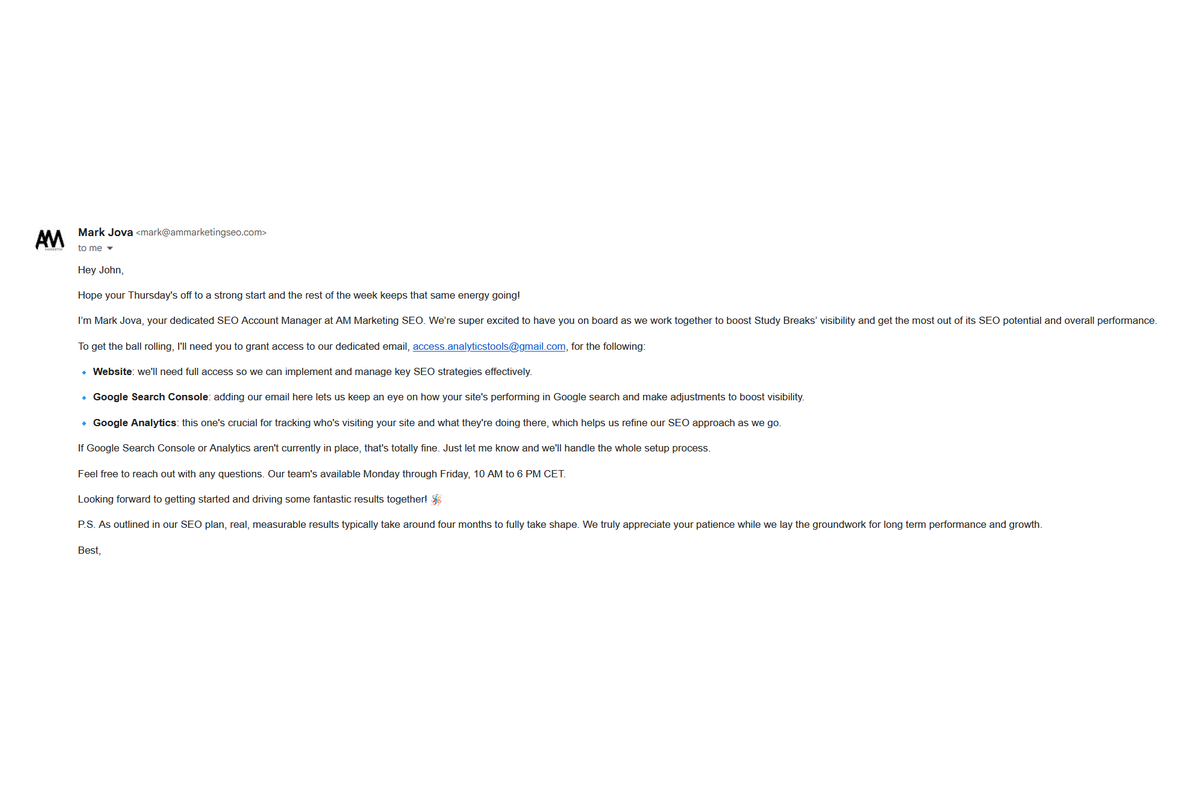
Then came weeks of the team just getting oriented, which, given our vast archive, took considerably longer than it might for a smaller site.
One of the first real deliverables was a Keyword Mapping Plan, which paired search terms with pages that already showed potential and flagged the gaps nobody had noticed.
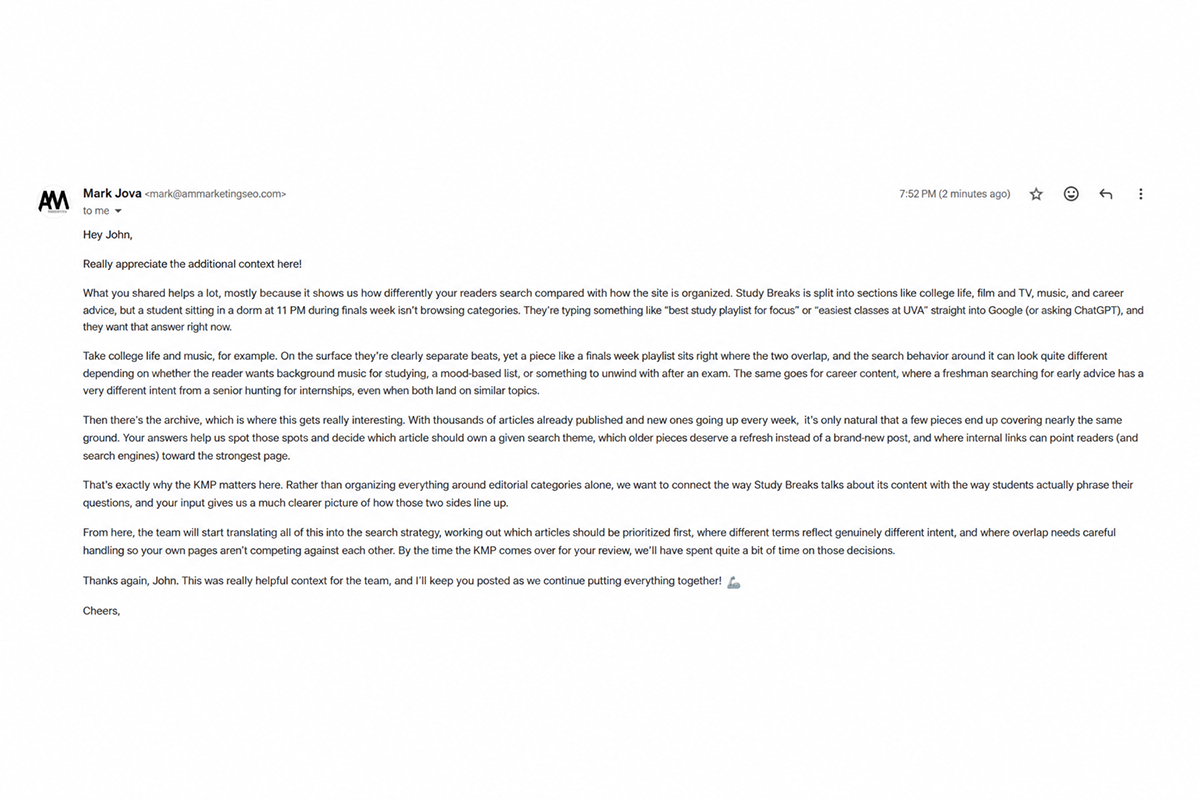
Come to think of it, that document is probably still the single most useful thing they ever handed us. With an archive our size, it’s embarrassingly easy to forget what you’ve already published and which topics you’ve covered more than once.
Before greenlighting yet another article on a familiar topic, it helps enormously to know something similar ran two years back and just needs another pass.
Sounds like a pretty basic thing, I know, but when you’re dealing with thousands of articles and new ones coming in every week, keeping track of it all is easier said than done.
Then It Got Hands-On, Article by Article
Once the planning phase wrapped, recommendations started landing on individual pieces. Titles, meta descriptions, headings, article copy, internal links, image alt text, page structure, the works.
Everything comes to us for review first, and how much attention any given article needs varies wildly. Our editors still make the final call on what runs, though more often than not, their decisions are shaped by the angles and context the SEO team brings to the table.
For example, we’d planned to publish a brand-new roundup of study playlists for finals week, but our SEO strategist pointed out that we already had an older playlist piece sitting on page two of Google for a very similar search.
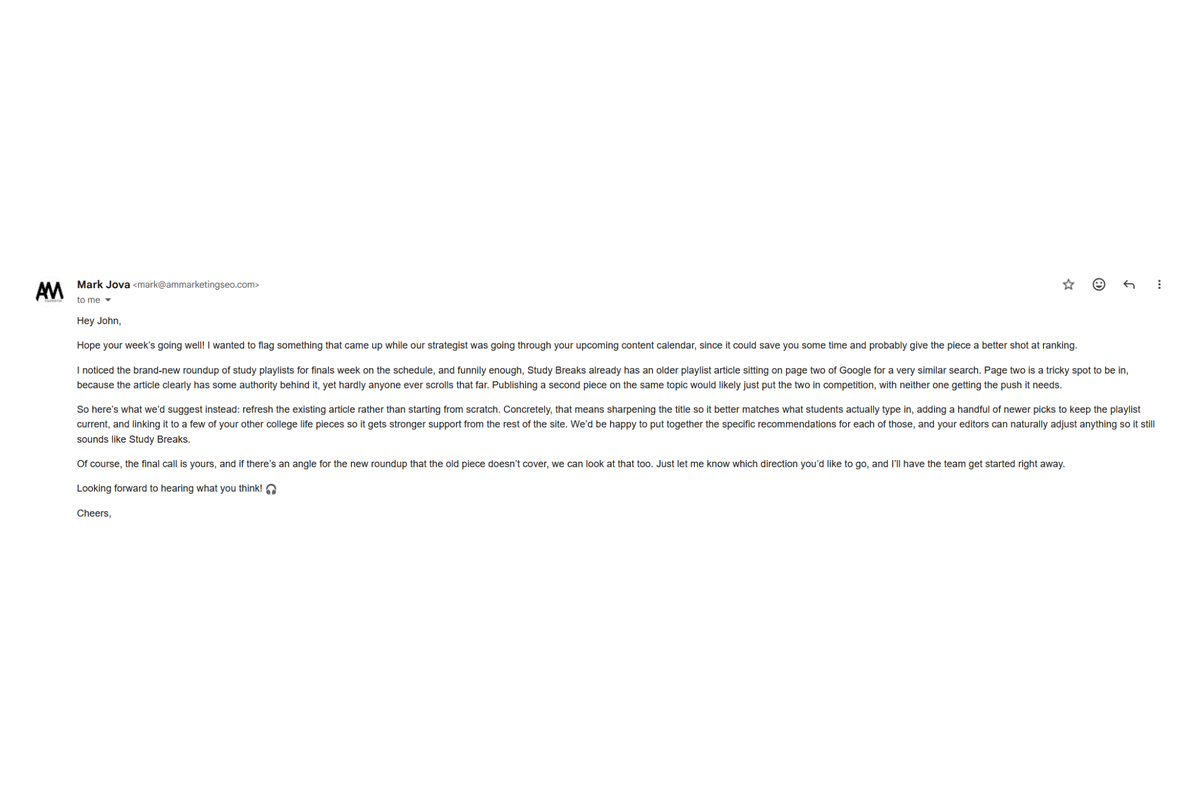
So instead of starting from scratch, we refreshed that article, sharpened the title, added a few newer picks, and linked it to some of our other college life pieces.
Turns out that did the trick. The article climbed in the rankings within a couple of months, whereas publishing a new one would probably have just left us with two pieces competing for the same searches.
We were never going to let every article start reading like it had been assembled around a keyword spreadsheet. To their credit, the team always respected our voice while working SEO into what was already there. And two years later, I’m happy to say not a single piece has ended up sounding that way.
Reviving the Archive Turned Out to Be the Real Win
If you had asked me two years ago where the biggest value would come from, I probably would have said new content.
Turns out, the real magic happened with the older material, the stories that had plateaued and were quietly coasting on whatever traffic they had left. Yet another win for AM Marketing SEO, and probably one of the more unexpected ones.
Publishing teams live in the present tense almost by nature. There is always another pitch to review, another deadline creeping up, right?
Meanwhile, something like our Easy-A UVA Classes piece just sits there quietly pulling in readers from Google, and nobody thinks to touch it again unless someone flags it.
AM Marketing SEO got genuinely good at spotting exactly those kinds of articles, the ones already carrying some search visibility that simply needed a fresh pass to keep serving the same readers.
Yes, There Are Backlinks, and Here Is How That Actually Works
Backlinks make up a real part of the service, and they’ve been secured every month since we approved the Keyword Mapping Plan.
The process is refreshingly simple from our end. Once we sign off on a Keyword Mapping Plan, their team secures placements with the agreed anchors across a broader network of sites they work with.
What I appreciate most is that none of it feels like a black box. Every link gets reported back, with the actual URL, placement, and metrics attached, so we can compare month over month and keep track of everything that has been secured.
Communication Without the Theater
Nothing about talking to this team feels like a ritual, and that has been one of the nicest surprises of the whole arrangement. After working with agencies that demand a weekly video call just to confirm everyone is still alive, this is a huge relief.
Most contact happens because something concrete needs doing. A report is ready. An article needs sign-off. Someone has a question about a page. Every so often the question runs the other way and we reach out first.
Support is email-based, with a 24-hour response guarantee, so we never sit through weekly status meetings. Our editorial team has enough on its plate without adding a standing call just to prove everyone still remembers their Zoom password.
When something needs a longer explanation, we ask, and we get an answer without the runaround.
The Reports Age Well
Every month brings an SEO report covering keyword movement, Search Console performance, on-page work completed, backlinks, technical issues, and upcoming priorities.
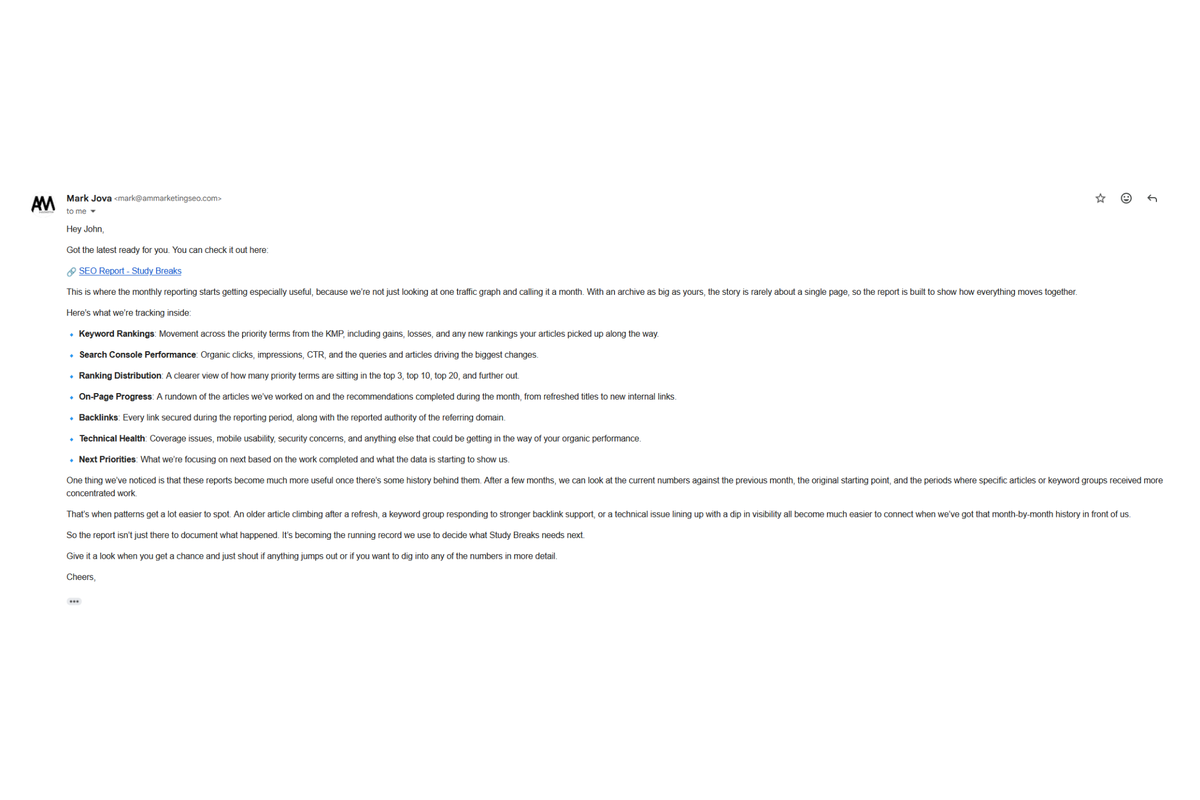
Early on, you skim the latest numbers and move on. Two years later, though, those older reports become something you find yourself reaching for constantly.
For example, if an article suddenly climbs in the rankings, we can pull up exactly when it was last touched and what changed. On the other hand, if a keyword has been bouncing around for months, there’s enough history to trace the pattern instead of guessing.
And I have to admit, seeing a keyword finally break out of that cycle and move in the right direction never really gets old!
What Results Actually Looked Like
This is naturally the part everyone really wants to know about.
We’ve watched pages gain visibility, older content regain footing, and new articles start ranking for terms relevant to what they cover. That includes some of our career and student advice content, like 5 Ways to Fast-Track Your Career as a Student, which picked up steady traffic after a round of updates.
Over that period, we’ve seen improvements across thousands of keywords and search phrases. Some climbed gradually, others made bigger jumps after specific changes, and plenty still move around from month to month. That’s just how search works, and we’ve learned not to get too excited or worried about every little fluctuation.
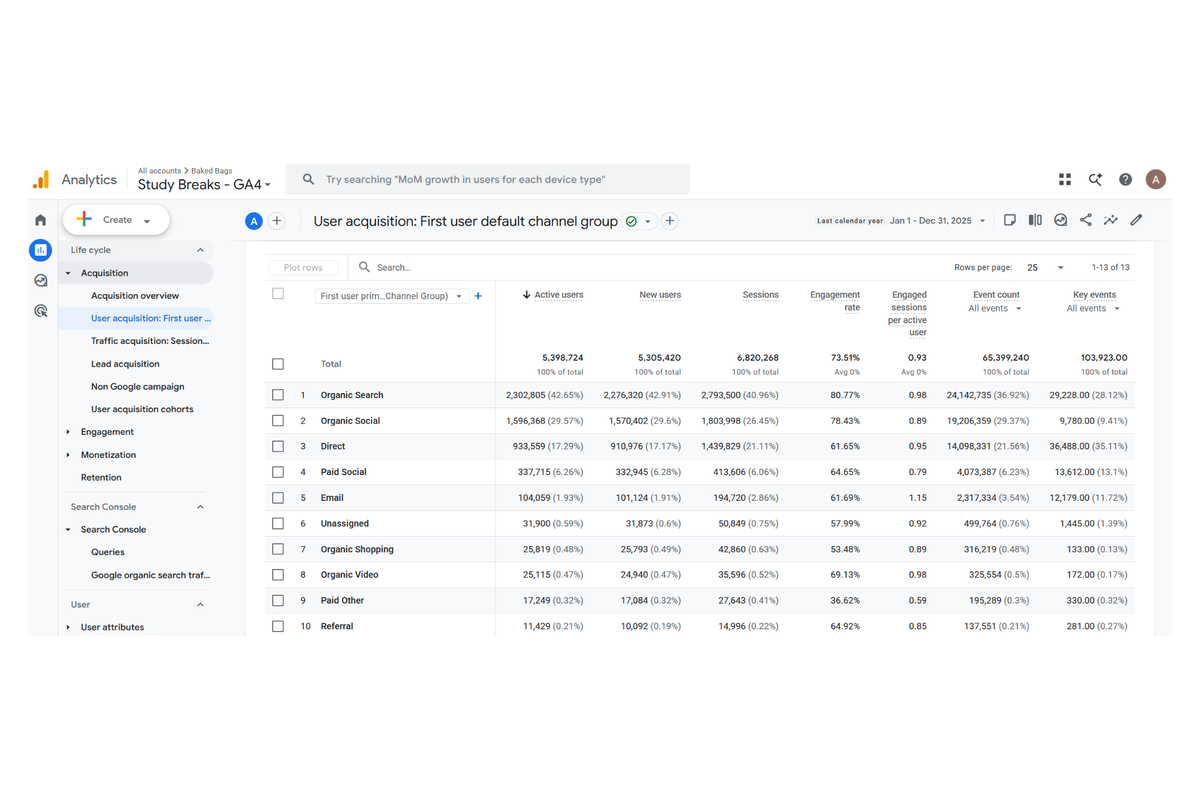
More importantly, organic search remains our biggest source of readers. In 2025 alone, it brought in roughly 2.3 million active users, or about 43% of our 5.4 million total, comfortably ahead of organic social (around 1.6 million, or 30%) and direct traffic (around 934,000, or 17%).
Those organic readers also turned out to be some of our most engaged, with an engagement rate of 80.8% compared with 73.5% across the whole site, which is exactly why we’ve continued investing in it.
What matters more to me now is the overall direction of the campaign. More of our articles are getting found, older pieces continue bringing in readers, and the work we’re putting into the archive is paying off.
Of the 5.3 million new users who discovered us last year, about 2.28 million arrived through organic search, and that’s the kind of steady, compounding return that makes the archive work feel worthwhile.
Search Keeps Changing, and So Has the Approach
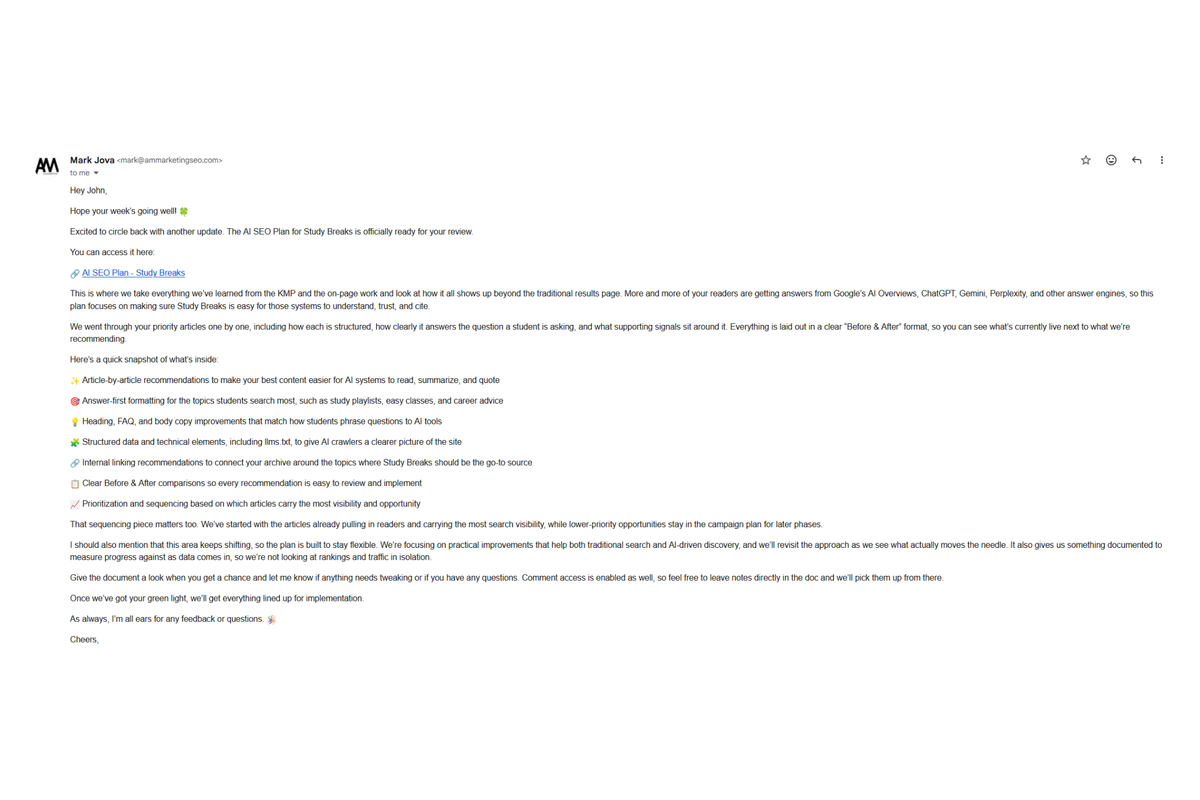
Search itself has gotten stranger over these two years. Google still dominates, obviously, but AI Overviews, ChatGPT, Gemini, and a growing list of answer engines have carved out space where people used to scroll through a normal results page.
AM Marketing SEO has been adapting the campaign accordingly, making articles easier for these systems to understand and introducing newer technical elements like llms.txt along the way.
We’re fairly cautious about making big claims here, since the whole landscape keeps shifting under everyone’s feet. Nobody can say with certainty which of these newer practices will matter most a year from now, and we’re certainly not pretending to have cracked some secret AI ranking formula.
For now, the goal stays practical: keep our content easy to understand, well organized, and adaptable as search itself evolves.
And that’s exactly what we’ve been doing for months now. The team has made these changes part of our regular SEO work, and I like knowing our content strategy is evolving right alongside the way people search.
On Price, Since Everyone Asks
AM Marketing SEO runs an offshore delivery model, with its SEO team based in Serbia, which explains a lot about why the pricing sits below many US agencies offering a similar range of services.
The offshore part has never felt like a big deal from our side. If anything, we actually like the arrangement. We get to work with people who know their way around SEO without paying the kind of agency rates that would make the whole thing difficult to justify.
And honestly, the day-to-day experience has been pretty straightforward. Emails go out, documents come back, work gets reviewed, reports arrive on schedule, and pages get updated. The fact that the team happens to be based in another country rarely crosses our minds.
For a publisher trying to get keyword research, on-page optimization, technical SEO, backlinks, and reporting under one monthly engagement, that pricing makes the whole package considerably more appealing.
We certainly wouldn’t have wanted to hire separate specialists for every one of those things, especially with the amount of content we already have to manage.
What We Would Tell Another Publisher Considering This
First, don’t expect to hand over your website and forget about it completely. Participation is still required on your end, and I actually think that’s a good thing.
They handle the SEO work, but you still need to provide access, answer questions, and review anything touching the live site. Your editors know your publication better than anyone, and that input matters when recommendations start coming in.
I’d also suggest giving the process some room to work. We saw progress along the way, of course, but two years gives you a far better perspective than two months ever could. That’s especially true when you’re working with a large archive where different articles need different levels of attention.
Where I think AM Marketing SEO makes the most sense is for publishers that already have plenty of content but haven’t had the time or resources to give it the SEO attention it deserves. That was certainly our situation, and it’s where we’ve seen the most value.
Where That Leaves Us
At this point, what matters is simpler than any pitch deck: does the work keep showing up, does it make sense, and is the campaign still moving somewhere worth going?
With AM Marketing SEO, the answer keeps coming back yes. The relationship has only gotten easier as the team has learned how Study Breaks actually works, article by article, month by month.
There are still articles to revisit, rankings to improve, and new search trends to figure out. I doubt we’ll ever reach a point where everything in our archive is perfectly optimized, and frankly, I don’t think that’s how publishing works anyway.
But having someone consistently looking after that side of things has taken a fair amount off our plate.
Roughly two years later, we’re still a client. That probably tells you more than another paragraph ever could.